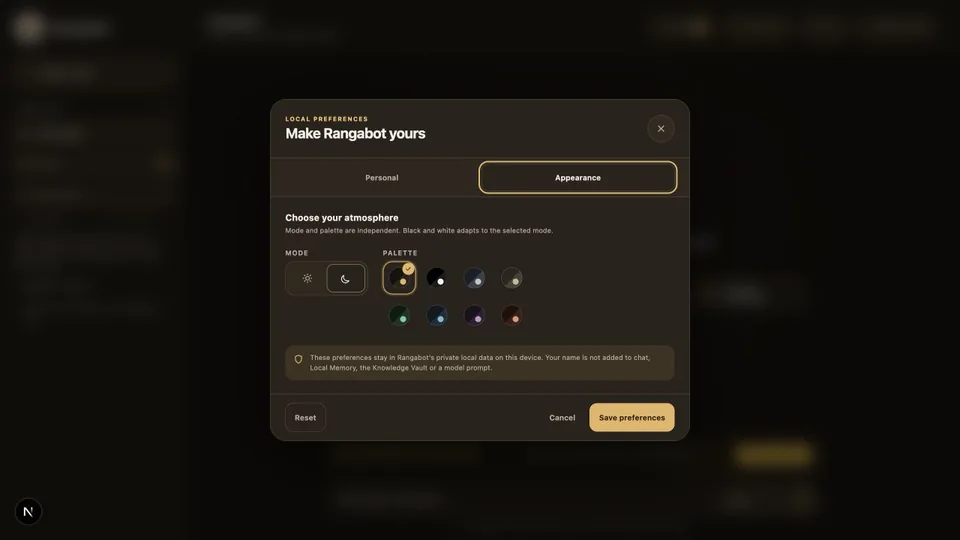
Personal companion · source available
Make the workspace yours.
Choose the welcome mix, appearance mode and palette while keeping personalization out of model memory.
 Rangabot
Rangabot coordinates local models, approved knowledge, selective memory and bounded tools—then shows enough of the process for you to remain in control.
These loops were captured from a clean local source candidate using an isolated temporary data root. The model endpoint was disabled; no personal profile, installed model, chat, document or local path was used.
Choose the welcome mix, appearance mode and palette while keeping personalization out of model memory.
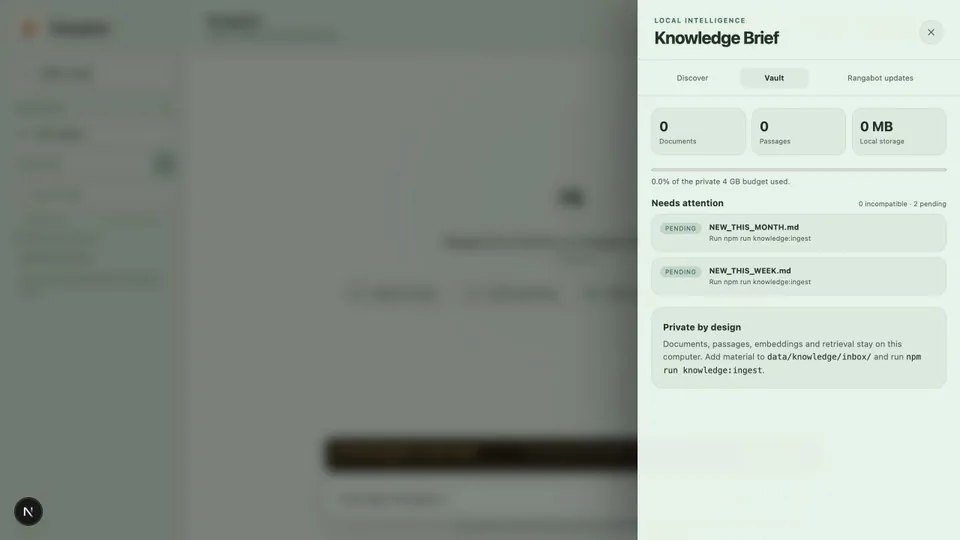
Move from current developments to vault health and the local changelog without exposing private documents.
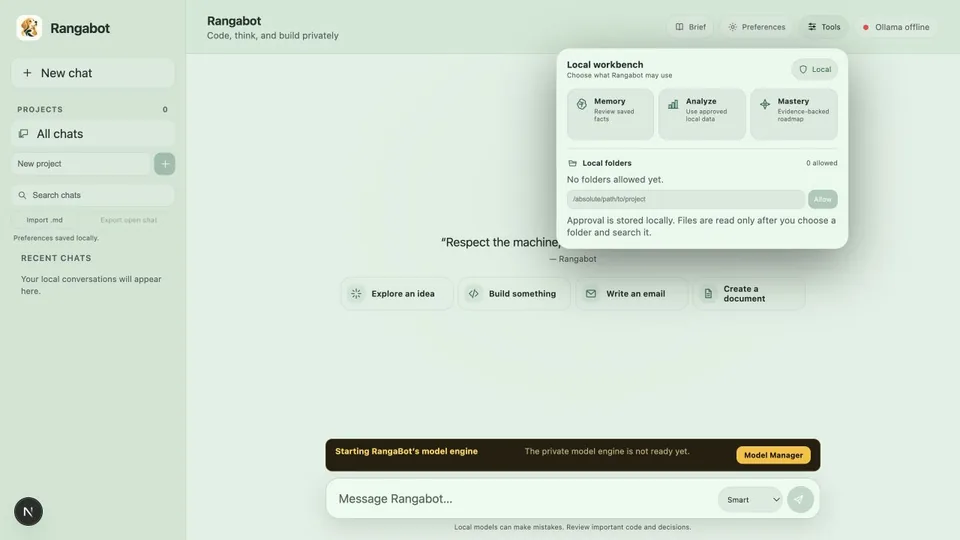
Memory and approved folders are source-available; bounded SQL analysis remains experimental and visibly permissioned.
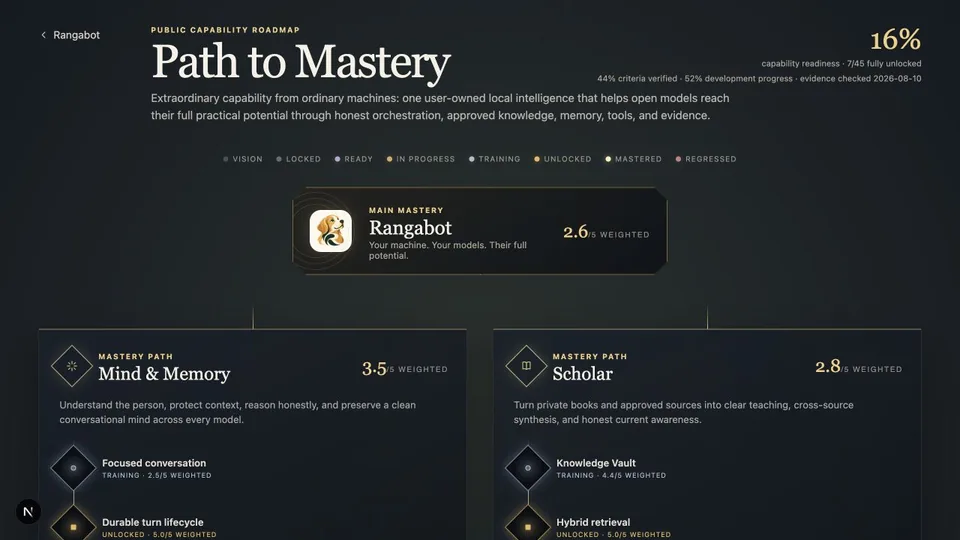
Open the public capability map, then inspect the criteria, dependencies and evidence behind one score.

Present in the public source tree; inspect the exact commit before installing.
Usable for bounded work, with an important quality limitation still open.
Implemented for a controlled preview, but not a supported public release.
A declared direction, not current functionality.
Start with a question. Smart mode can retrieve relevant local knowledge; Teacher mode tightens the evidence boundary; the workbench opens memory, analysis, mastery and approved folders without turning the composer into a control panel.
Model, source boundary and any calculation receipt remain visible.
Each path names the useful job, the control that keeps it trustworthy, and the boundary that should not be hidden by polished marketing.
Rangabot frames the current request, recent chat, approved context, tool boundaries and honest limits before the selected local model answers.
Choose a local name, light or dark appearance, one of eight palettes, and a fresh-chat mix of quotes, jokes, thoughts or cited lines from your own books.
Search, pin, reopen and delete local chats; start project-scoped work; and move readable transcripts between installations with bounded Markdown import and export.
Local memories are visible records—not an invisible profile. Create, inspect, edit, delete, export and review conflicts before importing anything.
The Knowledge Vault ingests supported local documents, combines keyword and embedding retrieval, and keeps source passages attached to teaching and synthesis.
Approve a CSV, Parquet or DuckDB file, attach it to one conversation, and let Rangabot link ordinary language to its schema before proposing a bounded read-only calculation.
Allow a repository folder, search eligible text on demand, attach a bounded line-numbered preview, or create a validated Word document through normal chat.
The desktop candidate distinguishes reviewed chat models, embedding models and unqualified installations, with hardware and license guidance before a large download.
Privacy boundaries are explicit, and Path to Mastery separates merged work from capabilities that have actually earned their gates.
The open-source application and the packaged desktop experience move at different speeds. These labels keep that boundary clear.
Full and smaller Light packaging paths are implemented for macOS arm64 and Windows x64. Light reuses an already-running local Ollama service; signing and clean-machine evidence still block public binaries.
Read the candidate update →Editing existing Word files, PDF reports, presentations and spreadsheets follow the available Word-creation foundation. Email drafting is local text work today; sending email is not implemented.
Inspect the acceptance criteria →A governed Windows x64 MSIX path is implemented but remains unsigned and untested on clean Windows machines. Packaged Linux and mobile applications remain roadmap work.
See how release claims are earned →Helpful and Needs improvement can be stored reversibly on one exact eligible candidate. Ordinary source builds keep the control disabled when their candidate manifest is unknown or mixed.
Read the candidate boundary →